
Garment Quality Control
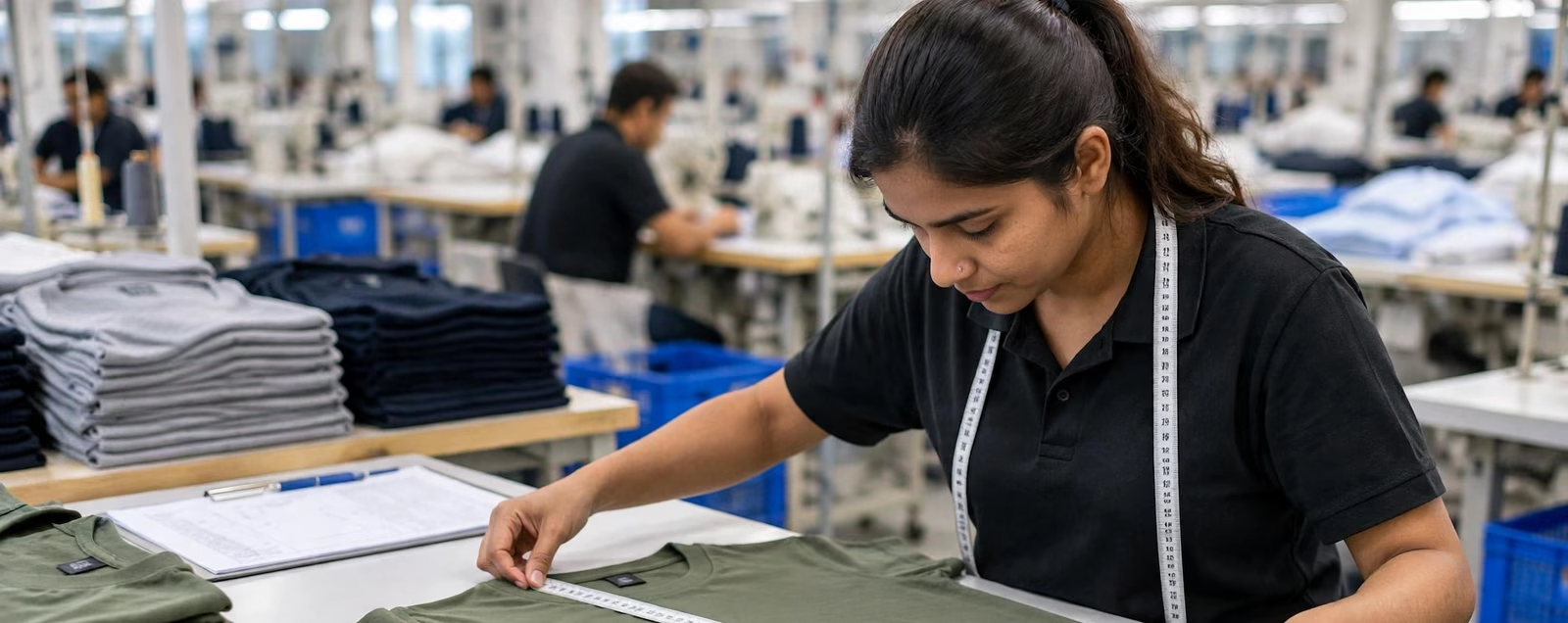
Garment quality control at a Bangladesh manufacturer, stage by stage
Every order passes through the garment quality control bangladesh manufacturer system set out on this page, checked stage by stage, from the fabric roll to the sealed carton. Nothing here is inspected only at the end: a fault found at final inspection has already cost cloth, sewing time and days, so the checking is spread across the whole making of the order, while faults are still cheap to put right. Every order is made to your level: your quality, your fabric, your design and your measurement, and the standard each stage is checked against is the sample you approved before bulk production began.
The checking runs in this order:
- Fabric inspection on arrival
- Cutting checks against your chart
- Inline checks while sewing runs
- Decoration checked against the approved sample
- Final inspection, piece by piece
- The packing audit, before the cartons are sealed
The clothing inspection process described below is the same for a first sample order and for a programme that reorders every season. Buyers who want the company behind the checks can read about us on the About page, and the ordering route the checks sit inside is set out in How to Order.
Fabric inspection on arrival
Fabric is checked when it arrives, before it is allowed anywhere near a cutting table. Each roll is looked over for:
- Knitting faults: holes, slubs, dropped stitches and the barring that shows as stripes once a garment is worn
- Shading, across the roll and between rolls, because two lots that look close in the store can sit visibly differently on a finished garment
- Weight, checked against the GSM you ordered
- Trims such as neck rib, matched to the body cloth from the same dye lot
The fabric is then rested before cutting, so it relaxes to its natural state and the finished measurements hold after washing.
Cutting checks against your chart
Cutting is where measurements are won or lost, so cut panels are measured against your chart before any sewing starts. Chest, body length, sleeve and shoulder are checked on panels from the top, middle and bottom of the lay, and a panel that falls outside your tolerance stops the bundle, not just the piece. Shade continuity is checked panel to panel, so the front, back and sleeves of one garment come from matching cloth. Sizes are bundled and marked separately, notches and drill marks are checked against the pattern, and only then does the bundle move to the sewing floor.
Inline checks while sewing runs
Checking does not wait for the finished garment. While sewing runs, pieces are taken off the line and measured, seams are pulled and checked for stitch density and strength, and collars, cuffs and hems are compared with the approved sample as the work comes past. A fault found at the machine is corrected on the bundle in front of the operator, and the machine setting is fixed before the next bundle starts. The same inline routine runs on every style we make, from fleece pieces in our hoodies and sweatshirts range to the piqué bodies in our polo shirts, because the cost of a fault is the same whatever the garment.
Decoration checked against the approved sample
Print and embroidery are checked against the approved sample, never against a screen or a file. Position is measured on the finished garment, and size, colour and stitch density are compared piece by piece with the sample you signed off. Before bulk approval, a decorated sample is washed, so you judge the print or the embroidery as your customer will see it after the first wash, not as it leaves the table. Chest prints, back prints and sleeve positions are set against the garment’s measurements for each size, so a design sits in the same place on a small as it does on an extra large.
Final inspection and the packing audit
At final inspection every garment is checked piece by piece:
- Measurements against your chart
- Stitching at every seam
- Shading between the pieces of one garment
- Cleanliness, with loose threads trimmed and the garment pressed before folding
Anything that fails is taken out of the order at this point, not folded in and hoped over. Buyers asking how our apparel quality assurance works usually mean this stage, but it only holds because the earlier stages have already removed most faults.
The last of the factory qc checks bangladesh orders pass through is the packing audit. Folded garments are counted and checked against your chart and your packing instruction: the right sizes in the right ratio, your label and markings on the right pieces, polybags and cartons marked to your format. The audit is recorded for the order before the cartons are sealed, so what the carton says is what the carton holds.
Questions buyers ask about our checks
What buyers most often ask us about the checking itself.
We sell in Germany. Can labels carry German wording, and is it checked?
Yes. Care and size labels are printed with the wording your compliance team supplies, in German where your programme needs it, and the wording is checked against your approved sample at the decoration stage and again at final inspection, so a labelling error is caught here rather than at your warehouse.
Our cartons go straight into US distribution. How are they marked?
Cartons are marked by style, colour and size breakdown in your format, and split by depot or store group where your instruction asks for it. The packing audit checks the marks against the contents before sealing, so cartons arriving in the USA can be booked in and forwarded without being opened and re-sorted.
Can we follow the checks while our order is being made?
Yes. The stage checks are part of the production record for your order, and the sales team reports them on request while the order is in work: fabric checked, cutting checked, sewing under way, final inspection done. Buyers placing a first order usually start with a sample, which passes through the same stages in miniature before any bulk is cut.
What happens to a garment that fails a check?
It leaves the order. Where the fault can be put right without weakening the garment, the piece is reworked and checked again; where it cannot, the piece is remade from the same fabric lot, so shade and hand feel still match the rest of the order. The packing audit then counts the order complete and correct before sealing.