
Garment Production Process in Bangladesh
From enquiry and tech pack to an agreed plan
Garment production process Bangladesh — the phrase covers everything that happens between a buyer’s first message and the sealed cartons leaving for export, and at Siatex each stage has a clear owner and approval. The process begins when a buyer sends an enquiry with a tech pack, a sample garment or a detailed description of the garment wanted.
The merchandising team studies the specification: style, fabric, sizes, colours, artwork and packing. Where anything is missing or unclear, questions go back to the buyer before work starts, because a question asked now costs nothing and the same question later costs time. Fabric choices, stitch details and finishing are agreed in writing, and the sampling and production timeline is confirmed against the plan.
If you have ever wondered how t-shirts are made in Bangladesh from the buyer’s side of the table, this is the honest answer: nothing is left to guesswork. The route every order follows:
- Enquiry and tech pack: the specification agreed in writing
- Fabric selection and lab dips: colour approved before bulk dyeing
- Sampling: the approved sample becomes the contract for the order
- Cutting and sewing: panels cut to the pattern, sewn operation by operation
- Decoration and finishing: print, embroidery and washing where the style needs them
- Final inspection and packing: checked piece by piece, packed to your instruction
Our how to order guide follows the same route, and explains what to send at each stage.
Fabric selection, dyeing and approval
Fabric is the foundation of the garment, so it is settled before any cutting is discussed. The buyer chooses the cloth and its weight: single jersey for t-shirts, piqué for polos, fleece for hoodies and sweatshirts, rib for cuffs and trims, or interlock for baby clothing. Our knit fabrics page describes the main cloths and their best uses.
Colour is approved through lab dips, dyed swatches sent to the buyer until the shade is right under the agreed light source. Where the buyer sends a swatch or reference garment instead, the match is made against that. Only approved fabric goes forward, checked on arrival for shade, weight, width and visible faults.
Trims are gathered in the same window: threads, labels, drawcords, buttons, zips and packing materials, each matched to the specification. Having fabric and trims approved before sampling means the sample is made from real materials, not substitutes.
Sampling and the approvals that lock the order
With fabric agreed, the pattern is made or adjusted to the buyer’s size chart and a first sample is sewn. The sample is measured point by point against the chart, checked for fit and construction, and sent to the buyer. This is the buyer’s moment to change almost anything: a longer body, a narrower collar, a different stitch, a moved print.
Changes are made and a revised sample follows if needed. Print designs are proved as strike-offs and embroidery as sew-outs, approved on fabric rather than on a screen. When the buyer approves the final sample, it becomes the contract for the order, the reference that cutting, sewing and inspection all work to.
Although every buyer follows the same broad clothing manufacturing process, the sampling stage is where their garment becomes individual. Two buyers can order a crew neck t-shirt on the same day and receive different garments, because each sample carries its own fabric, fit and finishing.
Cutting and sewing on the line
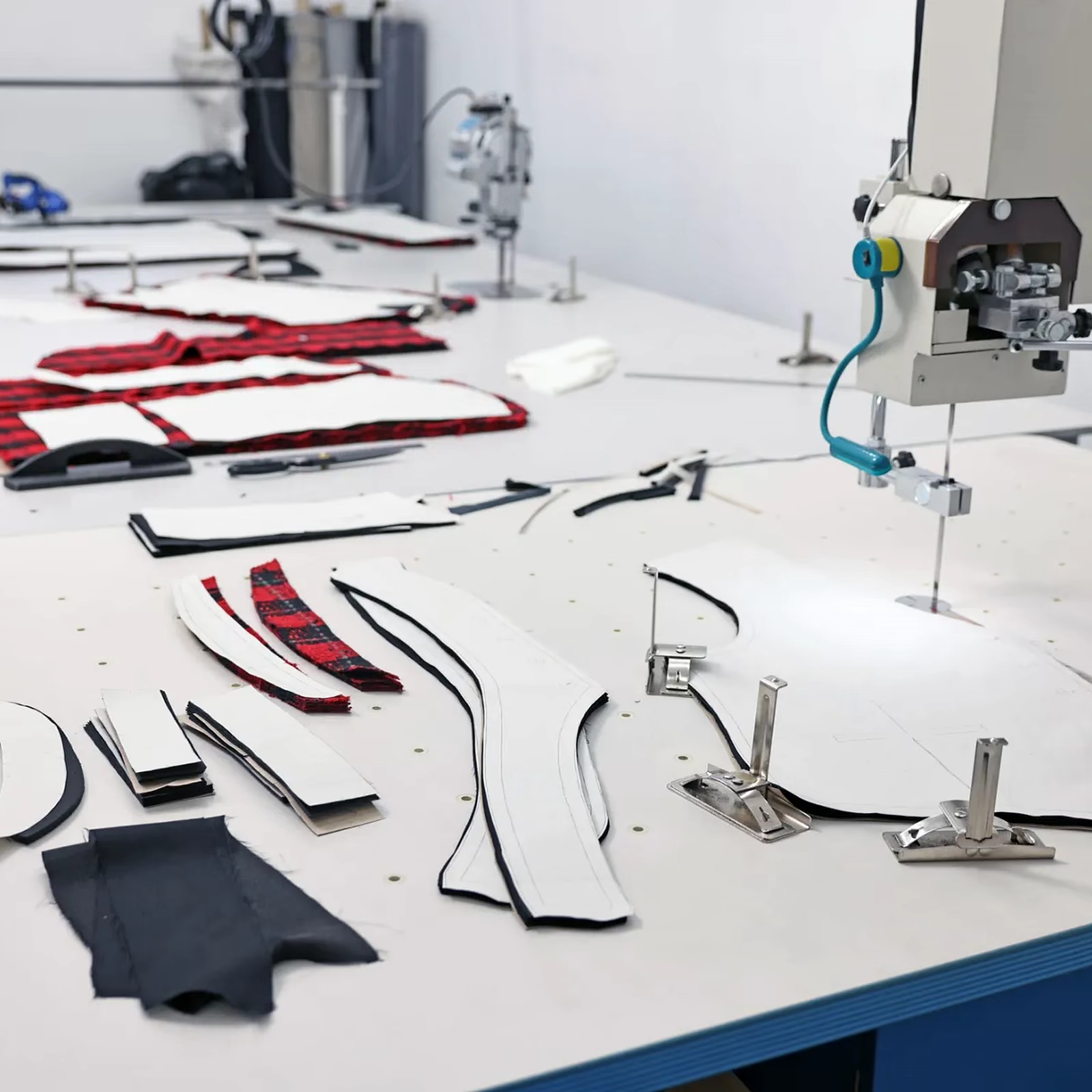
Production opens with fabric relaxation and spreading, so the cloth settles before cutting. Markers are laid to the approved pattern, panels are cut size by size, and every bundle is ticketed with its style, size and shade. Cut panels are checked against the pattern before leaving the cutting table, because a fault caught here never reaches a machinist.
Sewing is organised as a sequence of operations: for a t-shirt, joining shoulders, setting the collar, attaching sleeves, closing side seams, hemming and finishing cuffs, with each machinist handling the operation they know best. Supervisors check garments during sewing at intervals, so a drifting measurement is corrected on the line, not discovered at the end. The work takes place inside our garment factory, where sampling, cutting and sewing sit within one organisation.
Because every order is made to your level: your quality, your fabric, your design and your measurement, the approved sample travels with the order as the standing reference, and any doubt on the line is settled against it.
Printing, embroidery, washing and garment finishing
Where decoration is ordered, it is applied at the right point in the sequence. Screen printing is done on cut panels or finished garments depending on placement, and each print is checked for registration, colour and hand feel against the approved strike-off. Embroidery is stitched to the approved sew-out, with backing and thread colours matched to the buyer’s artwork.
Some styles are garment washed for softness or a particular finish, and are checked afterwards for shade and measurement, since washing can move both. Buyers who order plain garments skip this stage entirely; the process only includes the steps a given style actually needs.
A well-run apparel production process treats decoration and finishing as part of the garment, not as extras added at the end. Print position is measured to the specification, embroidery is inspected stitch by stitch, and nothing moves forward until the garment matches the approved sample.
Final inspection, packing and export preparation
Finished garments go through final inspection piece by piece, checked against the approved sample and the size chart:
- Stitching at every seam
- Measurements against the size chart
- Colour and cleanliness
- Labels in the right place, with the right wording
- Decoration against the approved strike-off or sew-out
Garments that fail are repaired where a repair is proper, or removed from the order where it is not. Pressing follows, so each garment is packed in its finished state.
Packing follows the buyer’s instruction exactly: individual folding and polybags, grouped sets, or retail presentation with hang tags and branded packaging. Quantities are counted at packing and again at cartoning, and cartons are marked with style, colour, size breakdown and destination so the buyer’s warehouse can check them in quickly.
The order closes with documents prepared for export and the cartons handed to the buyer’s chosen shipping route. The buyer receives confirmation of what has been packed, style by style, so the shipment can be checked against the original order.
Frequently asked questions
What do buyers in the United Kingdom need to approve before production starts?
Three things: the lab dip for colour, the garment sample for fit and construction, and any print strike-off or embroidery sew-out for artwork. Once those are approved in writing, production follows them exactly, and the approved sample is kept as the reference for inspection.
Can buyers in Canada change anything after sampling?
Small changes are easiest at the sampling stage, which is exactly what sampling is for. After bulk production begins, changes to fabric, colour or construction may no longer be possible, so the team will tell you honestly what can still be adjusted and what is fixed.
How will I know how my order is progressing?
The merchandising team updates you at the main stages: fabric approval, sampling, the start of sewing, inspection and packing. You do not need to chase for news, and if anything changes, you hear it from the team looking after your order.
What happens if a garment fails final inspection?
It does not go into a carton. Faults that can be put right are repaired and inspected again; anything that cannot meet the standard is removed, and quantities are reconciled before the cartons are sealed.